Should any questions, pls just contact us with jack@lionshee.com

 English
Views: 15 Author: Lionshee Marketing Dept. Publish Time: 2026-10-13 Origin: LIONSHEE


VERTICAL SOLAR FENCE | THE NETHERLANDS
Vertical solar gets written off a lot. Panels standing upright on a fence, the thinking goes, cannot keep up with a proper south-facing roof. A Dutch customer put that to a test on one property: 50 LIONSHEE 240 W flexible panels hung on a garden fence, monitored in the same app as the 36.72 kWp roof array next to it. In week 39 the fence produced 18.50 kWh per installed kWp. The roof produced 17.92.
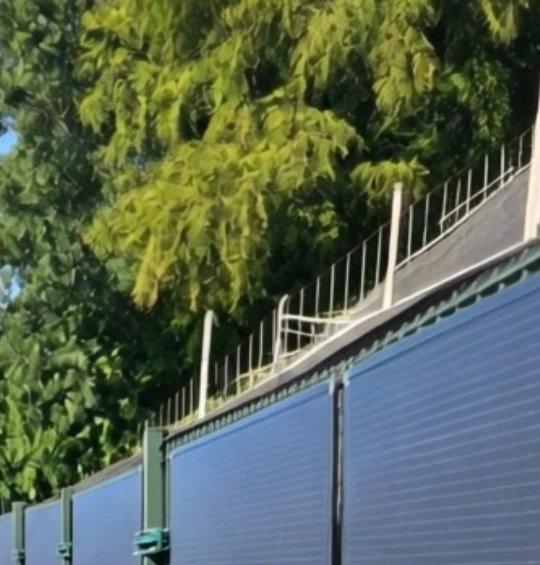 The upper run of the fence: flexible panels mounted vertically between the fence posts. Still from the customer's project video. |
| LOCATION The Netherlands | FENCE MODULES 50 × LS-SP240 | FENCE CAPACITY 12.00 kWp, vertical | WEEK 39 YIELD 18.50 kWh per kWp |
The property already had a large rooftop system: 102 panels of 360 Wp on the south-facing roof of the house, 36.72 kWp in total. Running along the edge of the garden is a long fence on a raised bank. Our customer, a Dutch solar company, used that fence as a second generating surface.
They fitted 50 LIONSHEE LS-SP240 flexible panels to the fence, standing vertically between the posts. At 240 W each that is 12.00 kWp. Both systems report into the same monitoring app, so the customer could compare them side by side, week by week, on the same site and under the same weather.
| Garden Fence | 50 Flexible Panels | Mounted Vertically | Same App As Roof | 18.50 kWh per kWp |
The fence is built on green steel posts. The LS-SP240 modules are held against it by brackets on the posts, in a continuous row along the length of the bank. A black membrane runs along the base of the fence below the modules.
Each module's pre-fitted output cables and MC4 connectors hang down the face of the fence and are gathered into a cable run along the bottom edge. There is no frame, no tilt structure and no foundation work beyond the fence itself.
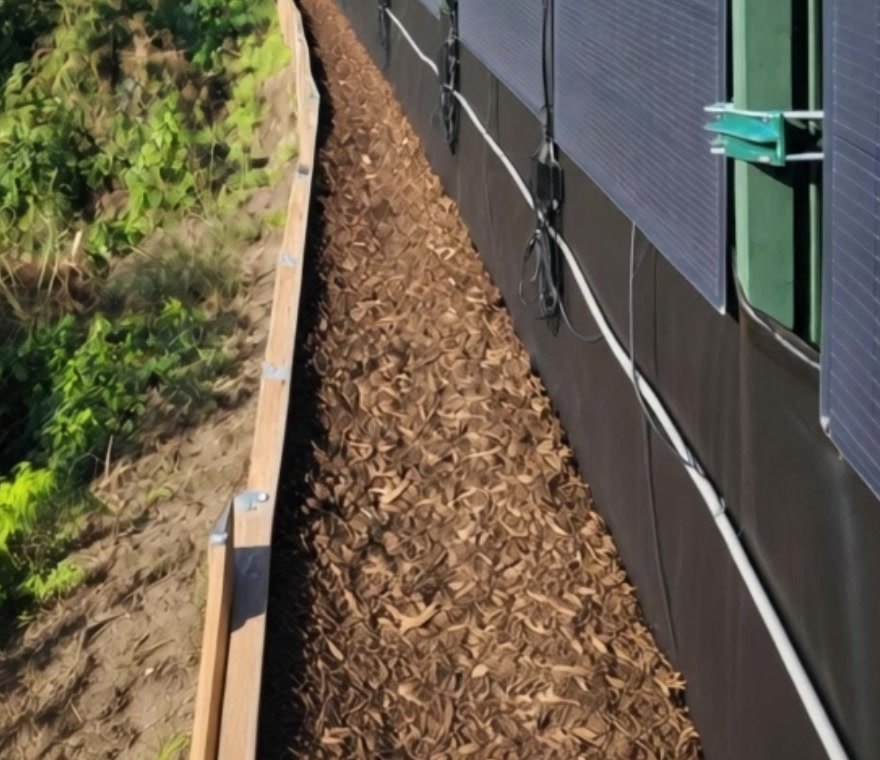 Brackets on the fence posts hold each module upright. | 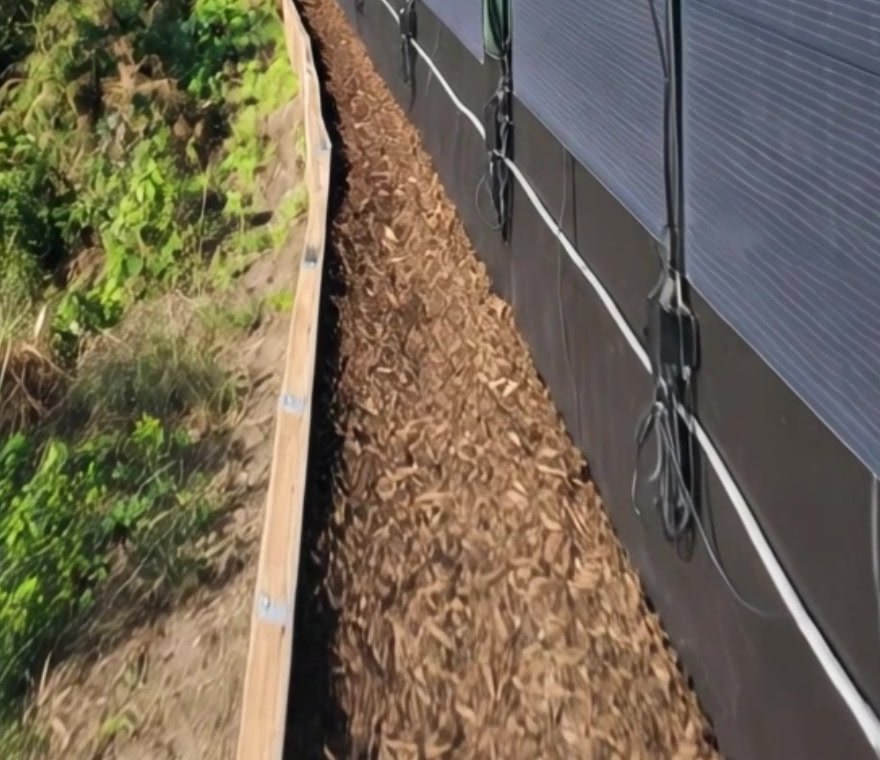 Module output cables gathered into a run along the base of the fence. |
Raw kWh will always favour the roof, because the roof has three times the capacity. The fair comparison is specific yield: kilowatt-hours produced per kilowatt-peak installed. The customer's monitoring app calculates it directly for each system.
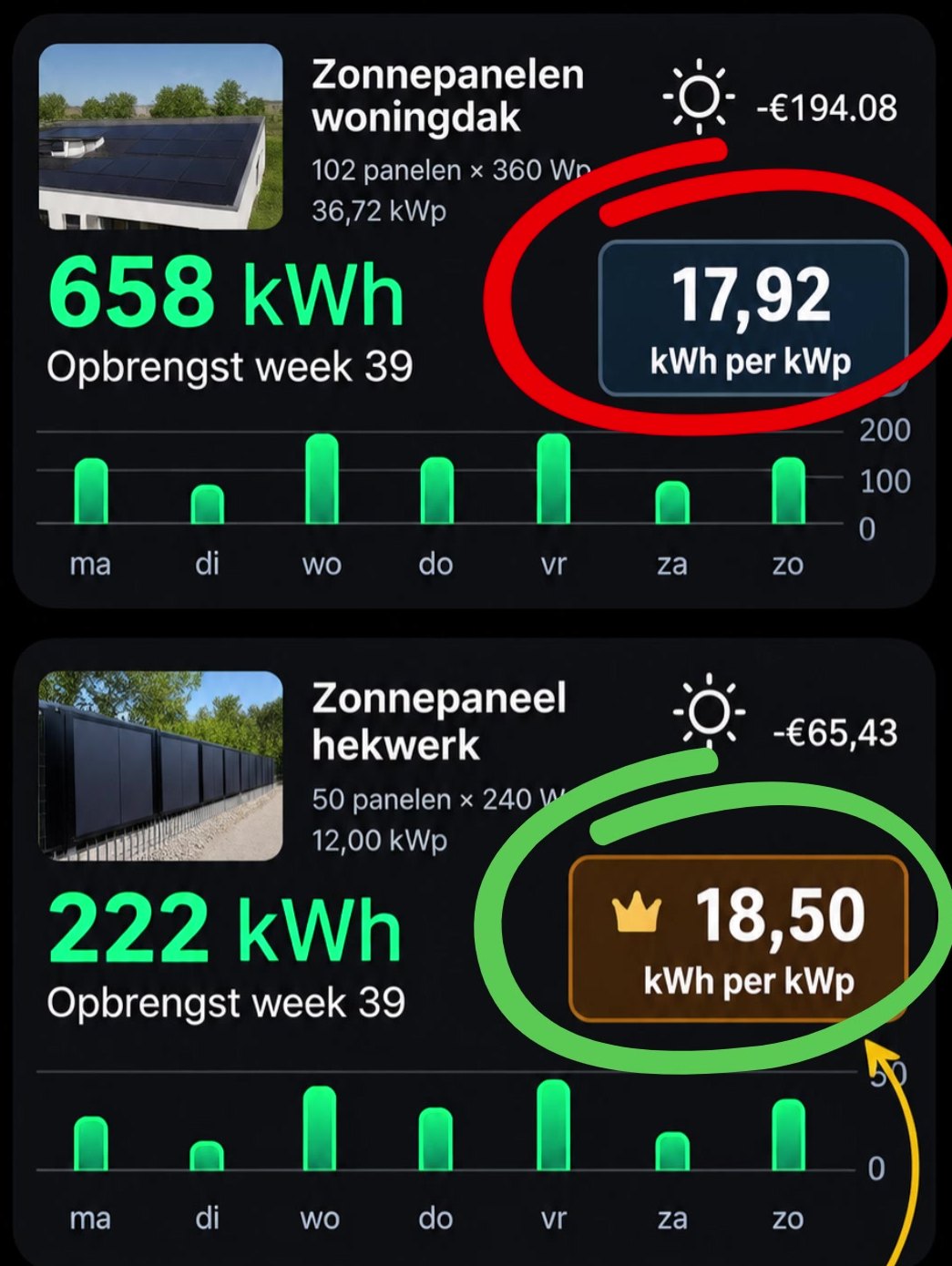 The customer's monitoring app, week 39. Top: the 36.72 kWp roof, 658 kWh, 17.92 kWh per kWp. Bottom: the 12.00 kWp fence, 222 kWh, 18.50 kWh per kWp. Circles added by the customer; app labels are in Dutch. |
Over the week, the fence produced 222 kWh from 12.00 kWp. The roof produced 658 kWh from 36.72 kWp. Per installed kWp, the vertical fence came out 3.2% ahead.
| South-facing roof | Vertical fence | |
|---|---|---|
| Modules | 102 × 360 Wp | 50 × LIONSHEE LS-SP240 (240 W) |
| Installed capacity | 36.72 kWp | 12.00 kWp |
| Orientation | Roof, facing south | Vertical, on the garden fence |
| Output, week 39 | 658 kWh | 222 kWh |
| Specific yield, week 39 | 17.92 kWh per kWp | 18.50 kWh per kWp (+3.2%) |
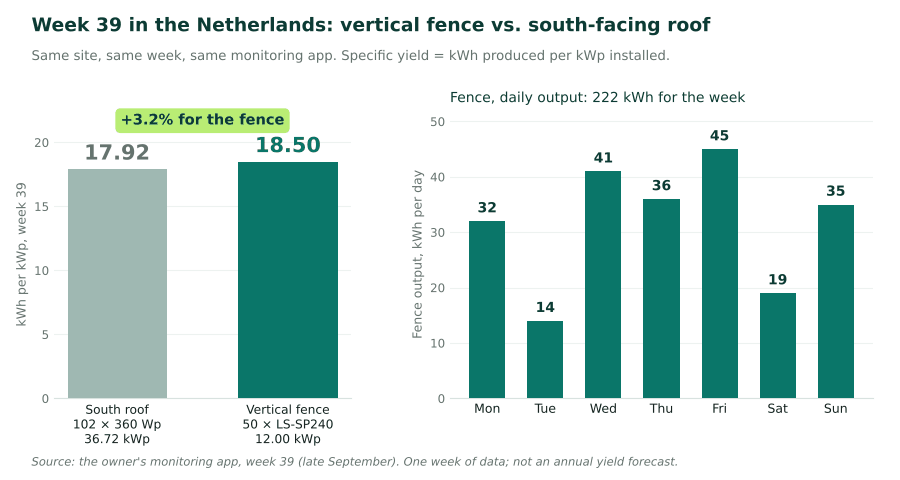
Left: specific yield for the week. Right: the fence's daily output, from 14 kWh on the dullest day to 45 kWh on the brightest. Chart drawn by LIONSHEE from the app figures above.
| “A lot people are sceptical about vertical orientations.” That is how the customer put it when they sent us the week 39 figures. This comparison answers the doubt with data rather than argument: one property, one week, one monitoring app, two specific-yield numbers. |
 The customer's original message, unedited: the comment quoted above, plus the August and September figures from an 800 W balcony system used in section 4. |
The data shows what happened; it does not by itself say why. Several general factors work in favour of a vertical array at this time of year, and any combination of them may apply here:
| One week is one week. Over a full year, a well-oriented roof at a good tilt is generally expected to produce more per kWp than a vertical surface; the vertical array's strengths show most in spring, autumn and winter, when the sun is low. What week 39 shows is that a vertical fence is not a write-off. On this site, in this week, it matched and slightly beat the roof per installed kWp. |
The same customer also shared monthly figures from one of the balcony systems it supplies. This is a separate installation, not part of the fence: a plug-in balcony system with 960 Wp of panels, an 800 W microinverter and no battery, facing south-east.
| Month | Output | Per installed kWp | Average per day |
|---|---|---|---|
| August | 64 kWh | 66.7 kWh per kWp | 2.1 kWh |
| September | 55 kWh | 57.3 kWh per kWp | 1.8 kWh |
For a plug-in system with no storage, around 2 kWh a day in late summer is a useful contribution to daytime household use, from a balcony that would otherwise generate nothing. The per-kWp and per-day columns are our arithmetic on the customer's monthly totals.
| Item | Project record |
|---|---|
| Location | The Netherlands |
| Site type | Residential property with garden fence and rooftop solar |
| Fence equipment | 50 × LIONSHEE LS-SP240 240 W flexible solar panels |
| Fence capacity | 12,000 W / 12.00 kWp |
| Mounting | Vertical, held by brackets on the fence posts |
| Fence module area | Approx. 63 m² (50 × 1150 × 1090 mm) |
| Fence module weight | 185 kg total (50 × 3.70 kg), excluding brackets and cabling |
| Reference system on site | Roof: 102 × 360 Wp, 36.72 kWp, facing south |
| Week 39 result | Fence 222 kWh, 18.50 kWh per kWp; roof 658 kWh, 17.92 kWh per kWp |
| Not part of the record available to us, and therefore not described: the exact compass bearing of the fence, the tilt of the roof array, the inverter or microinverters used on the fence, string layout and electrical protection. A qualified installer should check voltage and current limits, cable routing, fixing to the fence structure, wind loading and local regulations for any fence or wall installation. |
A fence is a long, thin, existing structure. It was not designed to carry the weight and wind load of framed glass modules, and it has no plane to tilt anything on. That changes which module properties matter.
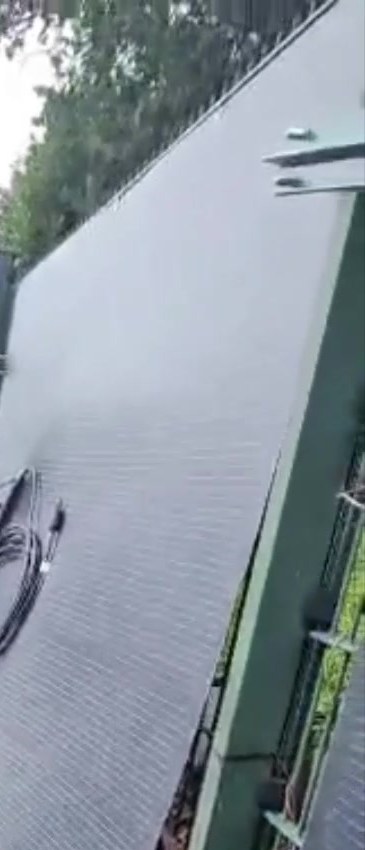 A module going up during installation. Light enough to be handled by one person. |
All 50 fence modules are the LIONSHEE LS-SP240 flexible panel. The figures below are from the current LS-SP240 datasheet.
| Specification | LS-SP240 |
|---|---|
| Peak power (Pmax) | 240 W; Vmp 23.10 V, Imp 10.39 A, Voc 28.56 V, Isc 10.98 A |
| Efficiency | 19.15% module (240 W over 1.25 m²); cell efficiency up to 25.8% |
| Dimensions and weight | 1150 × 1090 × 2.5 mm, 3.70 kg |
| Cells | 182 × 70 mm monocrystalline, 84 cells (6 × 14) |
| Temperature coefficient | Pmax −0.40% per °C; NOCT 45 ± 2 °C |
| Junction box and cables | IP67 junction box; 2.5 mm² output cables, 50 cm, MC4 connectors |
| Environmental | Protection class IP65; −40 °C to +85 °C; wind load 2400 Pa, snow load 5400 Pa |
| Warranty and certification | 3-year product warranty, 25-year power warranty; CE (LVD, EMC), RoHS, UKCA |
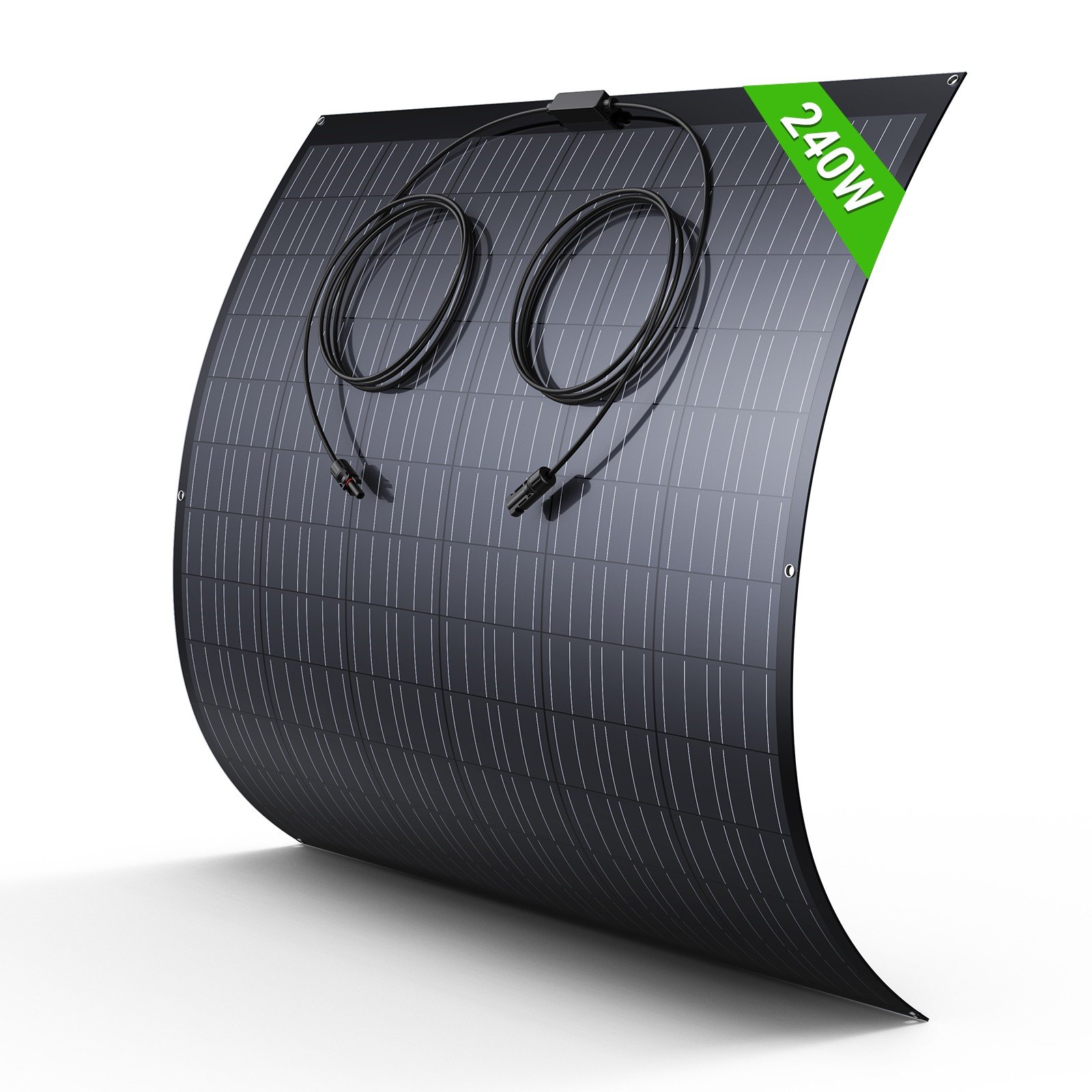 The LIONSHEE LS-SP240 flexible panel used on this fence: 240 W, 3.70 kg, 2.5 mm thick. Product image. |
Beyond flexible modules, LIONSHEE supplies balcony solar kits, microinverters, Smart Solar Hubs and modular LiFePO4 storage, so generation, energy management and battery capacity can be matched in one specification.
| Got a Fence, Wall or Railing That Sees the Sun? Send us the length and height of the surface, which way it faces and how you plan to connect it. We will come back with a module count, a layout and a packing plan. Local warehouse stock normally ships within three working days of order confirmation; if stock is short we tell you before the order is confirmed rather than letting the date slip quietly. Browse solar panels, balcony solar systems, microinverters, smart solar hubs and storage batteries, or download the datasheets from the download page.
Or email jack@lionshee.com directly with photos of the surface and your target capacity. |
Project photos, monitoring data and the customer message are published with the customer's permission. Photos are stills cropped from a video supplied by the customer; people and identifying details have been left out. The customer message is reproduced as received. Energy figures are the customer's monitoring app readings for week 39 and the customer's reported monthly balcony totals; per-kWp and per-day values are our arithmetic on those figures. No annual yield, savings or payback figures were available and none have been estimated. Module specifications are taken from the current LS-SP240 datasheet.


