Should any questions, pls just contact us with jack@lionshee.com

 English
 Views: 47 Author: LIONSHEE Marketing Dept. Publish Time: 2026-08-12 Origin: Site


The short version
On 27 August 2026 the UK legalises plug-in solar devices up to 800 W AC output. The specification it uses is built on the German standard DIN VDE 0126-95, adapted for UK conditions — which means Britain is deliberately adopting a format Europe has already stress-tested at scale. Germany alone registered 426,269 balcony solar systems in 2025. Meanwhile EU household energy use for space cooling has doubled since 2018, and household electricity averaged €28.96 per 100 kWh in the second half of 2025. The demand case and the legal case have arrived at the same time. The one thing the new UK route does not cover is batteries — and that distinction decides how your system gets installed.
If you sell, specify or install balcony solar, the useful question is no longer whether the UK market opens. It is what a market that opens on a borrowed specification will actually ask for. Britain did not invent its plug-in solar rules; it adapted Germany's. That makes several years of European deployment experience directly relevant — including the parts European buyers got wrong before they got them right. This article covers what the UK route covers, the price and cooling pressures driving demand across Europe, where storage sits legally, and what European installations look like in practice.
Before this change, plug-in solar could not legally be sold, supplied or used in the UK at all. The blocker was not hostility to the technology — it was that BS 1363 does not permit plugs and sockets to be used to connect electricity-generating equipment, so products could not demonstrate compliance with the Plugs and Sockets etc. (Safety) Regulations 1994 or the Electricity Safety, Quality and Continuity Regulations 2002.
DESNZ consulted between 16 and 30 June 2026 on fixing exactly that. The resulting instrument, SI 2026/848, was made on 16 July 2026 and comes into force on 27 August 2026.
| What the new route establishes | Detail |
|---|---|
| A new legal category | “Plug-in microgenerator” — solar PV only |
| Output ceiling | Maximum rated AC output not exceeding 800 W |
| Connection method | Standard plug and socket, plug type approved by a notified body |
| Product standard | Plug-in Solar Device Interim Product Specification v2, published 16 July 2026 |
| Baseline standard | The German DIN VDE 0126-95 approach, amended for the UK context |
| Grid code | Amendment to Engineering Recommendation G98 to allow connection |
| Territorial extent | ESQCR amendment covers England, Wales and Scotland; Northern Ireland follows a separate framework |
Two details in the consultation matter more than they first appear.
The first is the choice of baseline. DESNZ proposed using “the same broad approach as the German standard (DIN VDE 0126-95) as a baseline, with amendments for the UK context, to support future international harmonisation.” Britain is not writing a bespoke island standard. For manufacturers already building to German requirements, the gap to UK compliance is narrower than it would have been.
The second is the safety evidence. DESNZ commissioned an independent electrical safety study that tested plug-in solar products compliant with existing German standards against UK domestic wiring practice. Its overall conclusion was that plug-in solar products can be safely installed on UK domestic wiring provided minimum product standards are met. The UK did not open this market on optimism; it opened it on test results from European hardware.
One question was still open at consultation stage. DESNZ asked whether the specification should limit the number of microinverters to one per household or one per household circuit. Anyone planning multi-unit deployments in a single dwelling should confirm the final position before quoting.
European balcony solar did not grow because of policy enthusiasm. It grew because electricity got expensive and stayed expensive.
| EU household electricity price, H2 2025 | Per 100 kWh |
|---|---|
| EU average | €28.96 |
| Ireland (highest) | €40.42 |
| Germany | €38.69 |
| Belgium | €34.99 |
| Hungary (lowest) | €10.82 |
Source: Eurostat, EU household electricity prices stable in 2025, published 5 May 2026. Prices include all taxes and levies.
The EU average edged up from €28.79 to €28.96 per 100 kWh across 2025 — nominally stable, but well above pre-2022 levels, and increasingly made up of taxes and levies, which reached 28.9% of the final bill. Year-on-year movements in national currency were far less calm: Romania rose 58.6%, Austria 34.3% and Ireland 32.7% in the second half of 2025.
In the UK, the Ofgem price cap for 1 July to 30 September 2026 puts electricity at 26.11 pence per kWh plus a 57.19 pence daily standing charge. The standing charge does not move with consumption, so the only lever a household controls is how many units it imports.
The newer pressure is cooling, and it is not a summer story any more — it is a structural one.
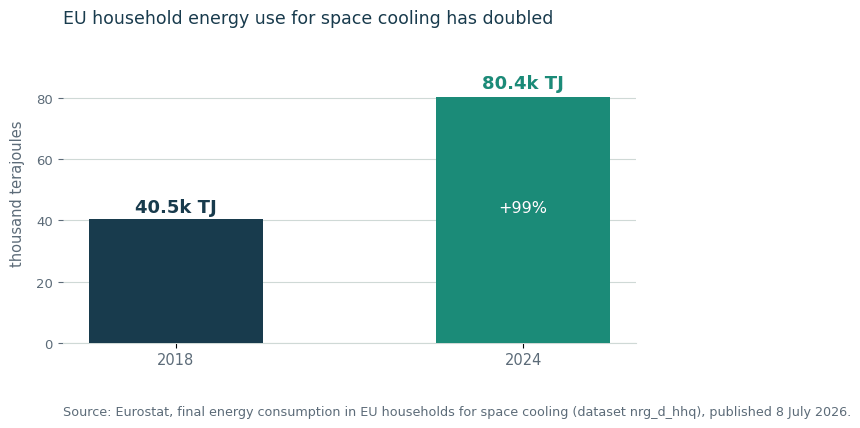
EU households used 80.4 thousand terajoules for space cooling in 2024, up from 40.5 thousand TJ in 2018. Source: Eurostat, dataset nrg_d_hhq, published 8 July 2026.
Energy used for space cooling in EU households doubled between 2018 and 2024, rising in every year except 2020 and 2023. Italy, Spain and Greece record the highest absolute consumption, at 26.3, 14.3 and 11.9 thousand TJ respectively. As a share of household energy use, Cyprus and Malta lead at 16.0% and 15.0%.
The summer of 2026 accelerated this further. Trade and media reporting through June and July described sharp increases in air conditioning shipments into Southern and Western Europe, with some portable units selling out. We have not independently verified individual manufacturers' sales figures and do not repeat them as fact here — but the direction is consistent with the Eurostat trend, and it changes what a household energy system is being asked to do.
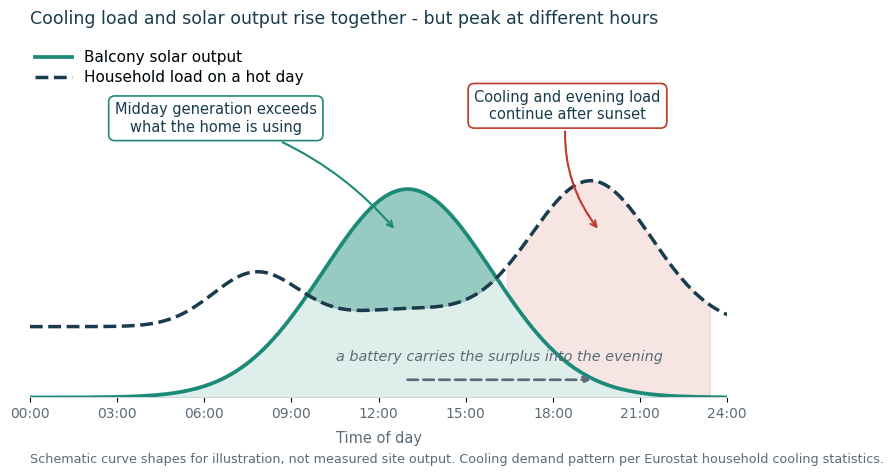
Schematic curve shapes for illustration, not measured site output. Cooling demand pattern per Eurostat household cooling statistics.
Cooling and solar share a season, which is the good news. They do not share an hour, which is the problem. Solar output peaks around the middle of the day; cooling load runs into the evening and often continues after sunset, alongside cooking and appliance use. Without storage, a balcony system exports its best hours and the household still imports power at full price when it actually needs it.
What storage actually changes
A balcony solar array without a battery reduces daytime import. A balcony solar array with a battery reduces evening import too — and evening is when a hot-weather household is running its cooling hardest. That is the entire difference between a modest bill reduction and a meaningful one.
This is the single most misread point in the current UK coverage, and it is stated plainly in the government's own consultation document.
The plug-in route covers solar panels with a microinverter. It does not cover batteries. DESNZ wrote that the consultation and proposed regulatory update “do not cover other forms of plug-in microgenerators, such as small-scale wind or battery storage systems,” and defined plug-in microgenerators throughout as plug-in solar systems without batteries. SI 2026/848 carries the same exclusion into law.
Balcony storage remains entirely legal in the UK. It follows the established route rather than the new one:
| Configuration | Route | What it requires |
|---|---|---|
| Panels + microinverter, ≤800 W AC | Plug-in microgenerator route, from 27 Aug 2026 | Product conforming to Interim Product Specification v2 |
| Panels + microinverter + battery | Conventional fixed installation | Registered electrician to BS 7671, DNO notification under G98, keep the EIC |
| Battery used off-grid | Outside parallel-operation rules | No export path; siting and sizing still apply |
We covered the UK compliance boundary in detail in our earlier article on the new UK plug-in solar rules. The short version for buyers: if a supplier tells you their plug-in battery became legal on 27 August, they have misread the instrument.
Germany registered 426,269 balcony solar systems in 2025 according to Bundesverband Steckersolar's analysis of Bundesnetzagentur data — and registrations are understood to undercount actual sales. That volume is why the practical lessons are worth more than the marketing claims.
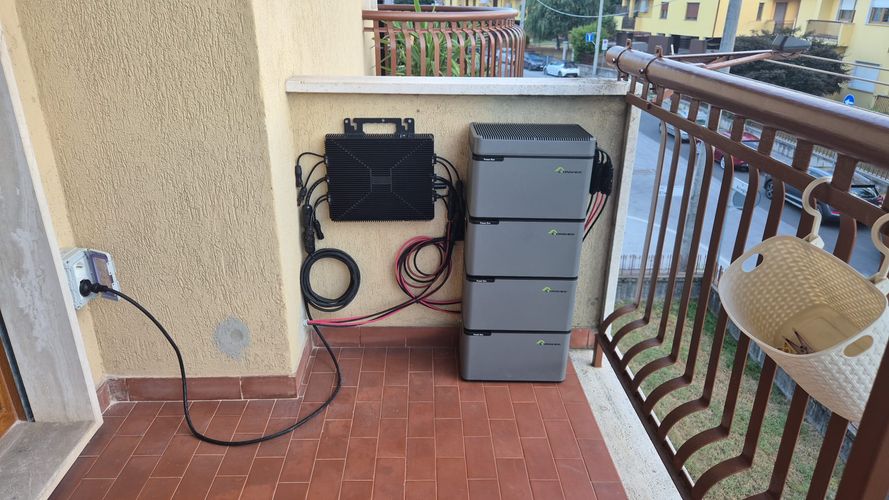
Customer installation, Italian apartment balcony. A four-module stack, a wall-mounted unit and a single cable run. Note that this is a storage configuration: in the UK a system like this is installed conventionally to BS 7671, not through the new plug-in route.
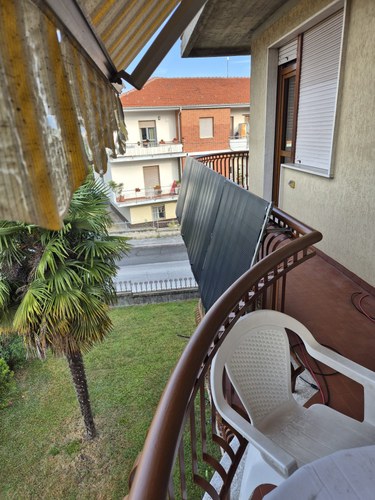
Customer installation, Italy. Railing-mounted panel on an apartment balcony — mounting angle and available width usually decide system size before electrical capacity does.
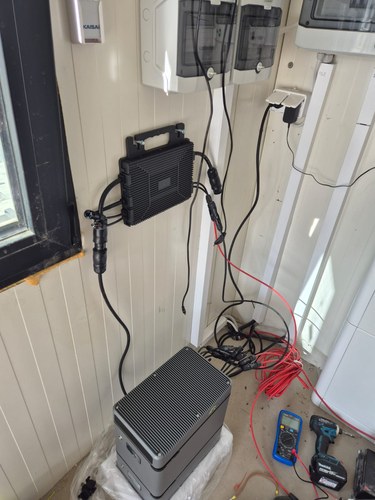
Customer installation, Poland. Wall-mounted microinverter with battery below, during commissioning. Cable routing and a tidy termination point matter more than most buyers expect.
Three things come up repeatedly across European projects:
Space decides capacity before electronics do. Balcony width, railing type and mounting angle constrain panel area long before the inverter rating becomes the limit. Specify the mounting first.
Modular beats maximum. Households that start with one battery module and add capacity after a season of real data end up with better-utilised systems than those that buy the largest stack upfront.
The cable run is the visible part. Installations are judged on tidiness. Plan the route, the termination and the trunking before the hardware arrives.

Customer installation, Germany. Two stacked modules with the cable run brought up the external wall.
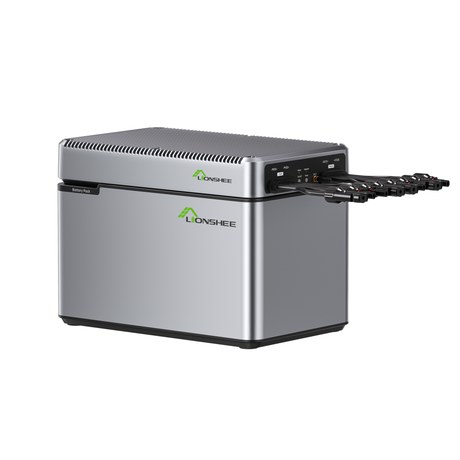
LS-L1024 Power Box, 1024 Wh per module.
The energy management centre: 1600 W output with two 800 W PV inputs (12–60 V, 25 A per channel), MPPT tracking efficiency of 99.90%, peak conversion efficiency of 98%, WiFi/RS485/CAN communication, IP65 protection, −20°C to 65°C operating range, 340 × 213 × 67 mm at 3.2 kg. Because it manages stored energy, a system built around it is an electrician-installed system, not a plug-in microgenerator.
Stackable LiFePO4 storage at 51.2 V nominal. The LS-L1024 holds 1024 Wh and stacks to six units for 6144 Wh; the LS-L2048 holds 2048 Wh and stacks to three for the same ceiling. Both are rated for 6000 cycles, carry IP65 protection and a 5-year warranty, and hold CE, ROHS and MSDS documentation. Low-temperature heating and a built-in fire extinguisher are available as options.
For the panels-only route: 800 W AC output at 230 V nominal, two independent MPPTs, 96% peak efficiency, IP67 protection, maximum DC input 60 V, recommended PV module power 280–550 W per channel.
One caveat, stated plainly. The 800 W class matches the ceiling set in SI 2026/848, but conformity against the Plug-in Solar Device Interim Product Specification v2 is assessed per model and must be confirmed in writing before any product is sold into the UK plug-in route. We do not describe any product as approved under the interim specification unless the assessment for that model supports it. Ask us for the documentation covering the exact model you intend to stock.
Stock held in the UK warehouse is typically dispatched within 3–7 working days of order confirmation; if stock is short for a particular model or quantity, we tell the customer before the order is confirmed rather than letting a delivery date slip quietly. German warehouse stock serves EU customers on the same principle. For distributors and installers this is the difference between quoting a domestic delivery window and quoting an import lead time.
No. The route covers solar panels with a microinverter rated at or below 800 W AC. Battery storage was explicitly excluded from the consultation and from the instrument. Balcony batteries remain legal but are installed conventionally, to BS 7671, with G98 notification.
DESNZ proposed using the broad approach of DIN VDE 0126-95 as a baseline, amended for UK conditions, to support future international harmonisation. It also commissioned an independent safety study that tested German-standard-compliant products against UK domestic wiring practice.
That depends on your tariff, your consumption pattern and your installation. What can be said from the data: EU household electricity averaged €28.96 per 100 kWh in the second half of 2025 and the UK cap rate is 26.11p per kWh for July to September 2026, while cooling demand keeps rising. We do not publish payback estimates, because they depend on site conditions we cannot verify for you.
Not automatically. A grid-tied system disconnects during an outage unless it has been specifically designed and installed with a backup output path, and air conditioning is a demanding load to back up. Treat self-consumption and outage backup as two separate requirements and specify them separately.
Start from measured evening consumption rather than the largest available stack. A modular approach — one module first, capacity added after a season of real data — consistently produces better-utilised systems across the European projects we supply.
Tell us your target market, expected volume and whether your customers need the panels-only plug-in route, the full storage system, or both. Send that and we will come back with:
A matched configuration with datasheets for the LS-H1600 Smart Solar Hub, LS-L1024 and LS-L2048 Power Box modules and LS-800Mi microinverter
The applicable CE, ROHS and MSDS documentation for the exact models you intend to stock
System connection guidance suitable for a BS 7671 installation and G98 notification
A current UK and German warehouse stock position with a realistic delivery window
Browse the range first if you prefer: balcony solar systems, storage batteries, smart solar hubs and microinverters. Datasheets are on the download page, and the compliance detail behind this article is in our UK plug-in solar rules guide.
Send your project requirements
Or email jack@lionshee.com directly with your configuration and target volume.
Sources
Plug-in solar: consultation document, Department for Energy Security and Net Zero, 16 June 2026
Government to make 'plug-in solar' available within months, DESNZ and MHCLG, 24 March 2026
SI 2026/848 — Plugs and Sockets etc. (Safety) Regulations 1994 and ESQCR 2002 (Amendment) Regulations 2026, legislation.gov.uk
EU household electricity prices stable in 2025, Eurostat, 5 May 2026
Energy use for cooling in EU households doubled in 6 years, Eurostat, 8 July 2026
LIONSHEE datasheets: LS-H1600, LS-L1024, LS-L2048, LS-800Mi (July 2026 revision)


